

Until I was twelve years old, I was educated in the French educational framework, where drama meant classical French playwrights. Going to the theatre usually meant productions like The Sound of Music or My Fair Lady. Then, it was decided that I would transfer to school in England. So, at age 13, I started at Westminster School. It was the late sixties, and the world opened up.
I attended a student performance of Waiting for Godot performed in French in a small room with a little stage, and I sat at the back. In terms of music, I was quite advanced – I already knew all the experimental sounds that had been happening. I’d seen the Mothers of Invention. I’d watched numerous performances. But I was unaware there was stuff like this. I suddenly became aware that, similar to music, there was a whole new world out there.
I don’t know how good the French was, but it wasn’t important what they were expressing. It was just so abstract and vibrant, with a kind of built-up suspense. And then, naturally, it erupts with the entrance of Pozzo and Lucky. The performance was put on by senior students, including Nigel Planer as Lucky. He was such a presence on stage. And he has to deliver that highly elaborate speech. In French. It was amazing.
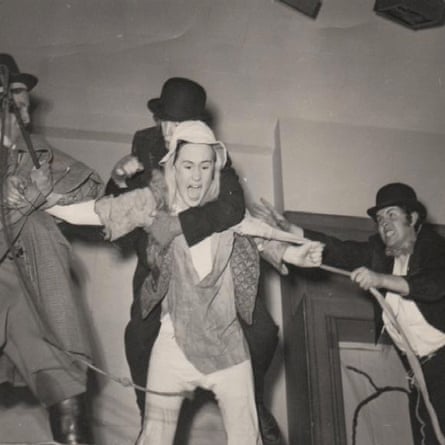
I was captivated by the notion that nothing really had to happen, you know? That an event took place and then it just goes on and then you have the young messenger at the end stating that Godot is not arriving today. It addressed time and action and narrative. Or their absence.
We had been taught all these guidelines about what drama was, but they were irrelevant here. I was deeply intrigued by the minimal action. Years afterward when I was producing music, I would attempt to transform them into something similar. When a new instrument came in, I’d pull out other instruments and deliberately isolate them. So you really heard that piano or that guitar or whichever element. That idea of less is more … I learned that with Godot.
And yet it possesses a narrative. It truly does. I mean, they are well-developed personas. They are so alive, the two protagonists, in their love for each other, like an old married couple. I don’t know how my life would have evolved if I did not attend that performance. To that school and that play then. It just awakened something in me.
We were released on Saturday afternoons, and I started going matinees at the Royal Court every time there was a fresh staging. So you would experience works by modern playwrights. But the entry point to all of this was Godot.
I have minimal memory of the performance itself, except I know that it was consistently engaging – it had me at the edge of my seat. What I learned is that there don’t have to be any rules. It certainly shaped how I worked with the bands that I signed to Ze Records. I even had the Waitresses write a song around “I Can’t Go On, I’ll Go On”. I just told them: “I want a song with this title.”
I think it made me more fearless, too, because you should not fret about failure if you embrace the playwright’s philosophy.


